Financial Literacy in Gamblers and Non-Gamblers
New research commissioned by the American Gaming Association (AGA) finds that gamblers display a higher rate of financial literacy compared to non-gamblers, and that “prediction market“ users tend to misjudge their mathematical skillset. The findings challenge conventional wisdom about gamblers and highlight the dangers of “prediction markets” misrepresenting gambling as a financial investment.
The study’s key findings include:
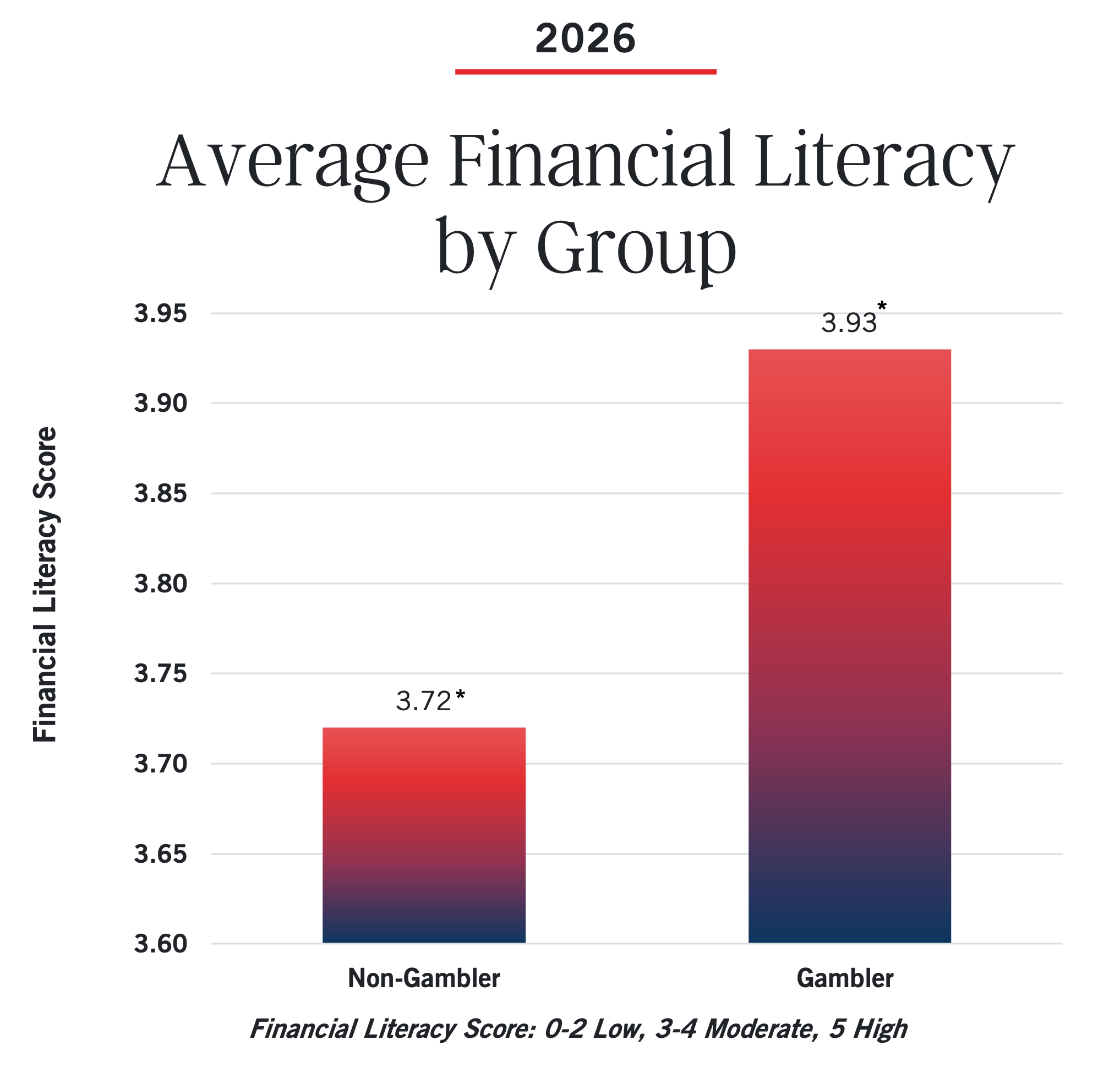
- Gamblers have higher financial literacy than non-gamblers. Gamblers scored an average of 3.93 out of five on a widely used financial literacy index, compared with 3.72 among non-gamblers, a statistically significant difference. 41% of gamblers qualified as highly financially literate, compared with 27% of non-gamblers.
- Prediction market users are more likely to misjudge their mathematical ability. Sports bettors show the greatest mathematical confidence and objective capability, meanwhile “prediction market” users expressed nearly as much confidence in their mathematical skills but performed more in-line with non-gamblers when those skills were objectively tested.
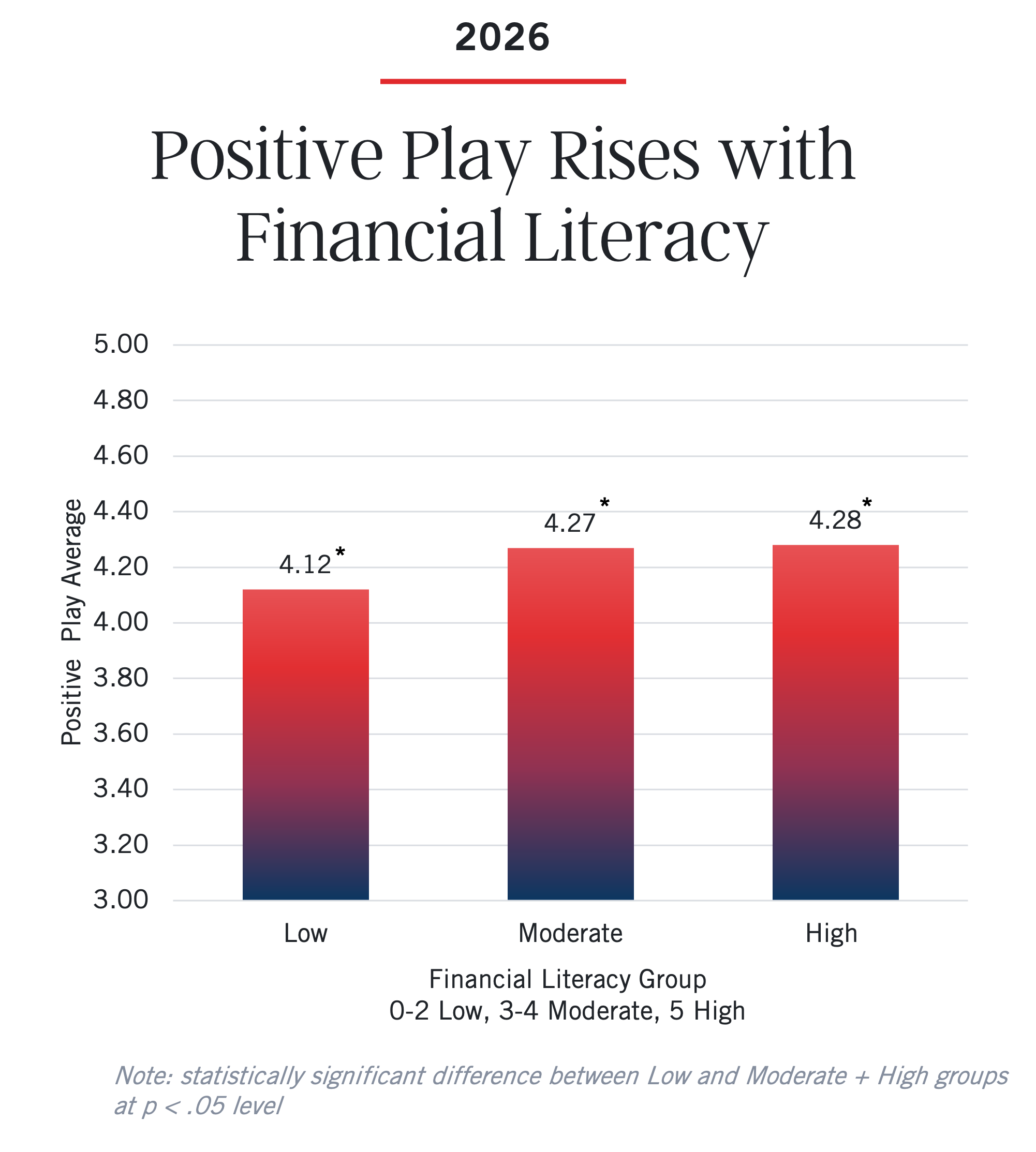
- Financial literacy is positively connected to responsible play. Participants with moderate or high financial literacy recorded significantly higher Positive Play scores than those with low financial literacy. The findings suggest that financial literacy education may strengthen responsible gaming resources by helping consumers better understand risk.
- Casino players reported the strongest responsible gaming behaviors. Casino players scored significantly higher on the Positive Play Scale than every other gambling segment, potentially reflecting their longstanding exposure to responsible gaming resources within mature, regulated environments.
The gap between “prediction market“ users’ confidence and demonstrated mathematical ability raises significant consumer-protection concerns. Consumers who are led to believe they have an analytical “trading” advantage may underestimate or misjudge the risks. Presenting sports wagers as investments and a money-making strategy compound the danger by encouraging users to believe they can outsmart what are often sophisticated counterparties they are led to view as peers.
The study concludes “there are clear implications for public policy and other industry stakeholders. First, gamblers scored higher in financial literacy than non-gamblers. Because gamblers exhibited elevated levels of subjective numeracy, yet identical actual math skills to nongamblers, campaigns like the AGA’s Play Smart from the Start are essential for fostering realistic consumer confidence and boosting gamblers’ understanding of risk.
Methodology
The researchers conducted a national online survey of 3,201 U.S. adults through Prolific from July 15–21, 2026. Following data-quality screening, the final sample included 3,149 participants: 537 sports bettors, 574 prediction market users, 557 casino players, 495 iGaming users and 986 non-gamblers. The survey has a margin of error of plus or minus two percentage points at the 95 percent confidence level.
The American Gaming Association commissioned the research. Colin López, Ph.D., founder and principal of IN Research & Analytics LLC, and Jackson Sears, Ph.D., founder and principal of Matrix Consulting Group of North Carolina, conducted the research and analysis. Both are co-founders of the Betting, Experience, and Trading in Sports (BETS) Research Center and an assistant professors at the University of North Carolina at Chapel Hill.